
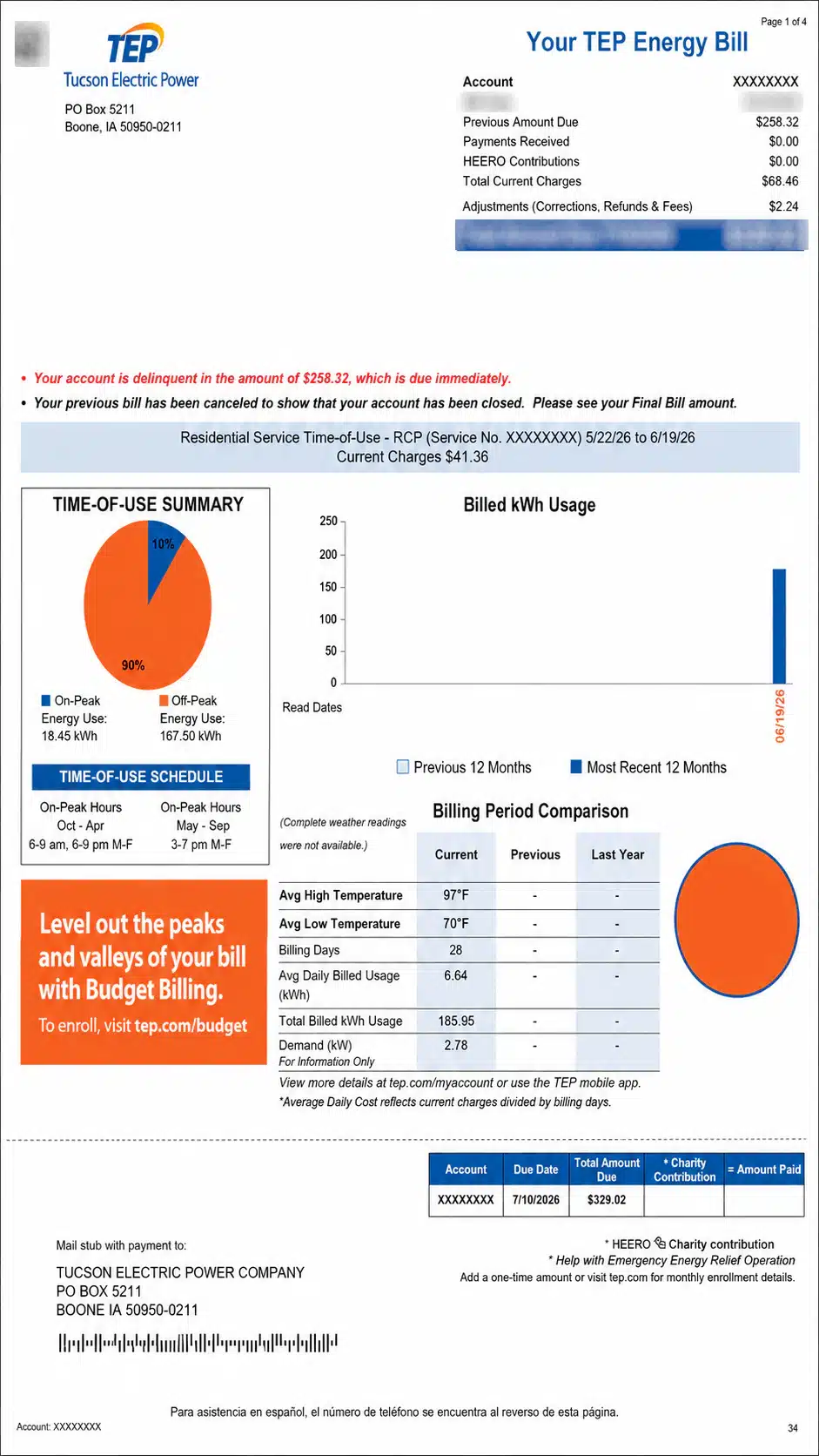
For many Tucson homeowners, the promise of solar was simple.
Generate your own electricity. Reduce your dependence on the utility company. Lower your monthly bills.
Then reality arrives.
You install solar. The panels work exactly as advertised. Your system produces thousands of kilowatt-hours every year. Yet every month, TEP still sends you a bill.
Sometimes it's a small bill.
Sometimes it's larger than you expected.
And many homeowners find themselves asking the same question:
If I'm generating all this electricity, why am I still paying TEP?
The Problem Isn't Your Solar Panels
In most cases, the solar system is doing exactly what it was designed to do.
The problem is timing.
Your solar panels produce the most electricity between late morning and early afternoon. Unfortunately, that isn't when most Tucson families use the most electricity.
The biggest electrical demand often occurs later in the day.
Around 5 p.m. to 9 p.m., temperatures are still high, air conditioners are running hard, dinner is cooking, televisions are on, laundry is getting done, and electric vehicles may be charging.
By then, solar production is dropping rapidly or has stopped altogether.
Your home still needs electricity.
That electricity usually comes from TEP.
You're Producing Power When It's Least Valuable to You
Many homeowners focus on how much electricity their solar system produces.
The more important question may be:
When is it producing electricity?
A solar system may generate far more power than the home needs at noon.
The challenge is that many households need that energy later in the day.
Without battery storage, excess electricity is often sent back to the utility grid. Hours later, when solar production falls and household demand rises, electricity is purchased back from the utility.
In simple terms, many homeowners are selling electricity during the day and buying it back later that evening.
For some people, that's perfectly acceptable.
For others, it becomes increasingly frustrating.
TEP Is Acting as Your Battery
Whether you realize it or not, most solar homeowners are using the utility grid as a giant battery.
Excess electricity is exported during the day.
Electricity is imported later when it's needed.
For years, that arrangement made sense. Battery systems were expensive and the economics often favored sending excess production back to the grid.
Today, battery technology has changed dramatically.
The cost of battery storage has fallen while capacity and reliability have improved.
That has many homeowners asking a different question:
Why rent a battery from the utility company when you can own one yourself?
The Homeowners Driving Battery Adoption
Not everyone needs battery storage.
Some homeowners are perfectly happy with their current arrangement.
Others have a different mindset.
They watch their solar production daily.
They know how many kilowatt-hours their system generated yesterday.
They understand exactly how much electricity they're buying from the utility each month.
And they get tired of seeing electricity leave their property during the day only to buy it back later.
These are the homeowners increasingly exploring battery storage solutions.
Not because they have to.
Because they want more control over the energy they produce.
Batteries Do More Than Save Money
The financial side gets most of the attention, but many homeowners discover another benefit once they start looking at battery systems.
Backup power.
A standard grid-connected solar system usually shuts down during a power outage.
That means your solar panels may be sitting in full Arizona sunshine while your refrigerator, internet, lights, and air conditioner are all off.
A properly designed battery backup system can help keep critical circuits operating when the grid goes down.
For many homeowners, that peace of mind is just as important as reducing their utility bill.
Is More Battery Storage the Next Step?
Ten years ago, installing solar panels was often enough.
Today, many Tucson homeowners are realizing that solar generation is only part of the equation.
The next step may not be adding more solar panels.
It may be storing more of the electricity you're already producing.
If you're tired of sending excess energy to the grid, concerned about outages, or simply want to get more value from your existing solar system, battery storage may be worth exploring.
JCP Electric can evaluate your electrical system, discuss your energy goals, and help determine whether additional battery storage makes sense for your home.