
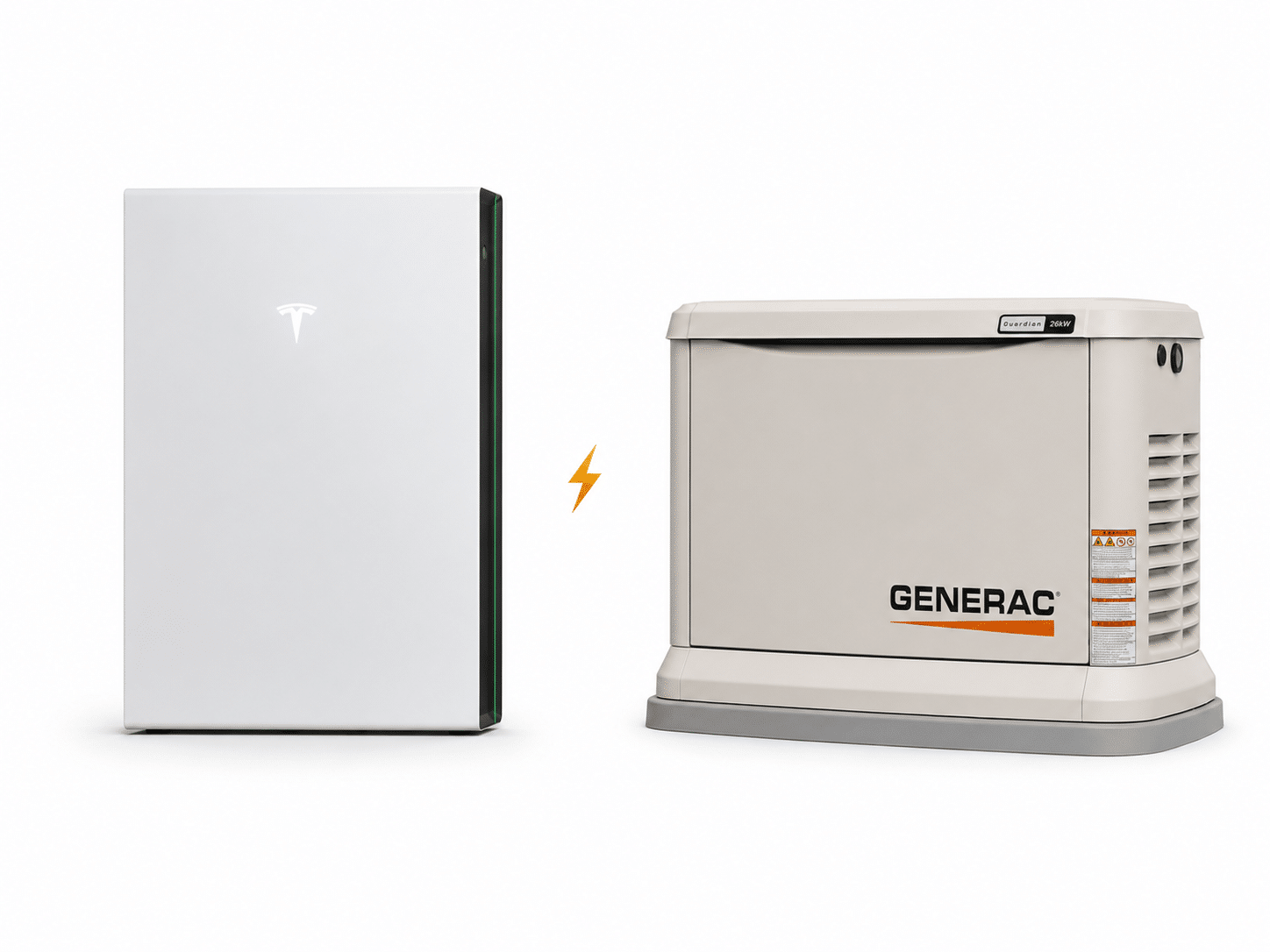
When Tucson homeowners start looking into backup power, one question usually comes first:
Should I install a home battery backup system or a standby generator?
There is no single answer that works for every home. Batteries and generators solve the same basic problem in very different ways. One may fit your needs better, or the best solution may be to use both.
JCP Electric installs battery backup systems and standby generators. We are not tied to one brand or one type of equipment. Our goal is to help you choose a backup power system that makes sense for your home, budget, and priorities.
The quick answer:
Already have solar?
A battery backup system is usually the logical next step.
Do not have solar?
A natural gas or propane standby generator is often the better value if your main goal is backup power.
Want the greatest protection against outages?
A battery and generator can work together.
The First Question: Do You Already Have Solar?
This is usually the best place to begin because solar changes what a battery can do for your home.
If You Already Have Solar
A battery backup system is often the natural next addition to an existing solar installation.
Without a battery, most standard grid-connected solar systems shut down during a utility outage. This is an important safety feature that prevents electricity from being sent back onto power lines while utility crews are working.
Adding properly designed battery storage can allow your solar panels to continue providing usable electricity during an outage. The solar system can recharge the battery during the day, while the battery supplies power when solar production falls or stops.
A battery can also provide value when the utility grid is operating normally. Depending on your electrical rate plan and system configuration, you may be able to store solar electricity and use it later instead of purchasing as much power during more expensive hours.
For homeowners who already have solar, a battery does more than provide emergency power. It helps them use more of the electricity their panels are already producing.
Learn more about battery backup systems in Tucson.
If You Do Not Have Solar
If you do not have solar and your primary goal is keeping the house powered during an outage, a standby generator is often the more practical starting point.
A generator does not need solar panels to replenish its available energy. As long as it has access to natural gas or propane, it can continue producing electricity for an extended period.
This can make a generator especially useful for homeowners who want to operate central air conditioning, refrigeration, lighting, medical equipment, and other important loads during a lengthy outage.
A battery can still be installed without solar. It may be charged from the utility grid and used for backup power or energy management. However, once its stored energy has been depleted during an outage, it cannot recharge until another source of electricity becomes available.
For a homeowner without solar who mainly wants long-duration emergency power, a generator will frequently provide more backup capacity for the investment.
Learn more about standby generator installation in Tucson.
What Are You Trying to Accomplish?
The next question is not about equipment. It is about the problem you want the equipment to solve.
You Want to Keep the Power on During Short Outages
Either a battery or a standby generator can protect a home during a short utility outage.
A battery usually responds almost instantly. In a properly configured system, you may only notice a brief flicker before the battery begins powering the protected circuits.
A standby generator normally takes several seconds to detect the outage, start its engine, and transfer the home onto generator power. That brief interruption is rarely a problem for ordinary household use, but it is not as seamless as a battery.
You Want Backup Power for Several Days
A generator generally has the advantage when the outage lasts for an extended period.
A battery contains a limited amount of stored electricity. Its runtime depends on the size of the battery and how much power the home is consuming. Running central air conditioning, electric water heating, an oven, or other large loads can drain a battery much faster than operating only lights, refrigeration, internet equipment, and a few outlets.
A natural gas generator can continue operating as long as the gas supply remains available. A propane generator can continue running as long as there is fuel in the tank.
If your greatest concern is maintaining whole-home power through a multi-day outage, a standby generator may be the stronger single solution.
You Want to Lower Your Electric Bill
A generator only provides value when it is running. A battery may be able to provide value every day.
Some battery systems can charge from solar panels or during lower-cost utility periods and then supply electricity when grid power is more expensive. The actual savings depend on your rate plan, energy use, battery settings, and system design.
If your goal includes both backup power and better control over when you purchase electricity from TEP, a battery has capabilities that a conventional generator does not.
You Want Quiet Backup Power
Battery systems operate quietly and produce no exhaust at the home.
Generators have an internal combustion engine. Modern standby generators are designed for residential use, but they still create noise and exhaust and must be installed with proper clearance from doors, windows, property lines, and other structures.
For homeowners with close neighbors or limited outdoor space, installation conditions may play a major role in the decision.
Can a Battery Run Your Air Conditioner?
It can, but the better question is how long it can run it.
Central air conditioning is often one of the largest electrical loads in a Tucson home. A battery system must provide enough power to start the equipment and enough stored energy to keep it operating.
One battery may comfortably operate lights, refrigerators, internet equipment, fans, and selected outlets, yet provide only a few hours of central air conditioning. Larger battery banks can provide longer runtime, but they also increase the cost of the system.
A generator can usually support large loads for longer periods, provided it is sized correctly and has an adequate fuel supply.
This is why backup power should be designed around actual electrical loads instead of broad claims about powering an entire house.
Do You Need Whole-Home Backup?
Not every backup system needs to operate everything in the house.
Many homeowners choose an essential-loads system that prioritizes refrigeration, lighting, internet equipment, garage doors, medical devices, selected outlets, and perhaps a smaller air-conditioning system.
Others want the ability to continue living almost normally during an outage, including operating central air conditioning and larger appliances.
Essential-load backup generally requires less battery capacity or a smaller generator. Whole-home backup requires more available power and careful load management.
Before choosing equipment, it helps to decide what you genuinely need to keep running and what can remain off until utility power returns.
The Best Backup Power System May Include Both
A battery and a generator are often presented as competing products. In reality, they can complement each other.
The battery can provide immediate, silent power as soon as the grid fails. It can handle short outages without starting an engine and may provide daily value through solar storage or energy management.
If the outage continues and the battery begins running low, a properly designed generator system can provide longer-duration power. Depending on the equipment and configuration, the generator may power the home, recharge the battery, or support selected electrical loads.
This gives the homeowner two different sources of backup power rather than relying entirely on one system.
For maximum resilience:
A battery provides immediate response, quiet operation, and stored electricity.
A generator provides long-duration backup when fuel remains available.
Together, they reduce the likelihood that one limitation will leave the home without power.
Which Is Better: A Battery or a Generator?
Neither technology is universally better.
For a homeowner who already has solar, a battery backup system is usually the logical first choice. It can store solar electricity, provide automatic backup power, and help the homeowner get more value from the existing solar installation.
For a homeowner without solar whose main concern is keeping the house powered through a long outage, a natural gas or propane standby generator is often the better first choice.
For homeowners who want the highest possible level of protection, a battery and generator can be designed to work as part of the same overall backup power strategy.
The correct choice depends on your electrical loads, available fuel, existing solar system, desired runtime, installation space, and budget.
Questions to Answer Before Choosing a System
Before recommending a battery, generator, or combined system, an electrician should understand how you expect to use it.
- Do you already have solar panels?
- Are you planning to install solar in the future?
- Do you have natural gas service?
- Do you want to power the whole house or only essential circuits?
- Does the system need to operate central air conditioning?
- How long do you want the home to remain powered?
- Are you interested in managing time-of-use electricity costs?
- Would you like the ability to expand the system later?
These answers matter more than the name printed on the equipment.
Backup Power Installation in Tucson
JCP Electric installs battery backup systems, standby generators, transfer equipment, dedicated backup circuits, and related electrical components for Tucson-area homeowners.
We are brand neutral and can help you compare available technologies without automatically steering you toward a battery or a generator.
Whether the right answer is a battery, a standby generator, or both, the system should be designed around your home and the electrical loads you consider most important.
Contact JCP Electric to discuss backup power options for your Tucson home.