
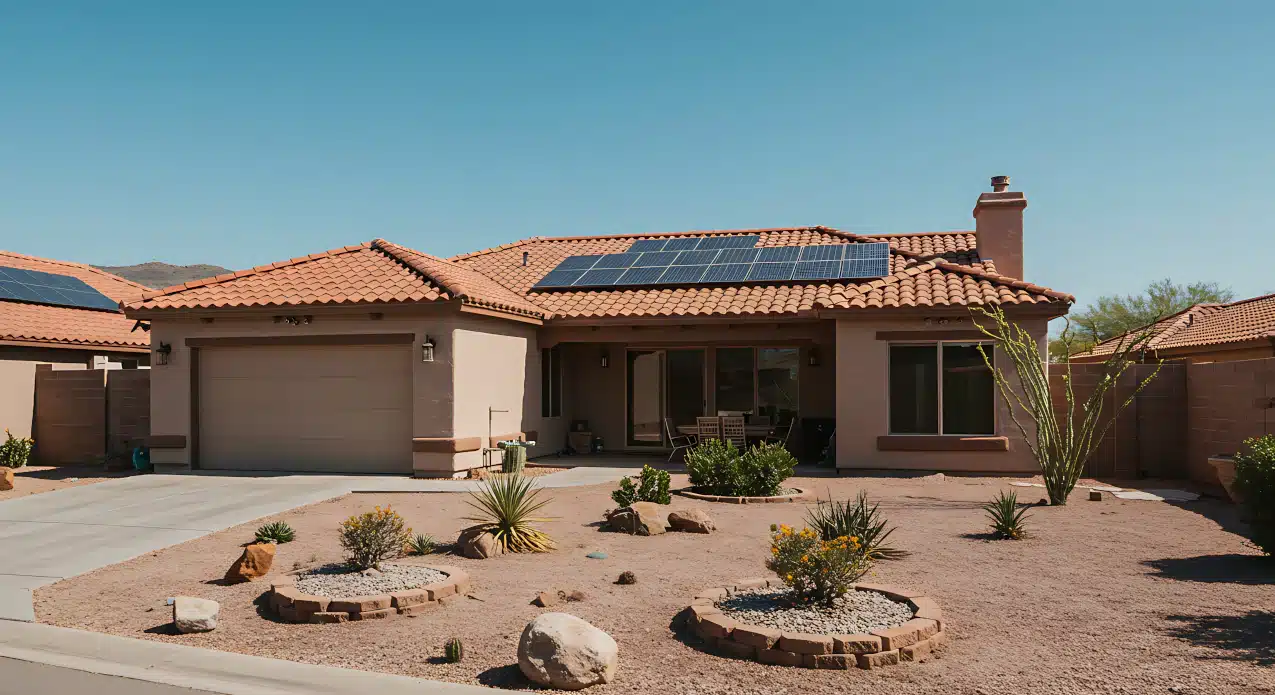
For years, solar power in Tucson came with a simple promise: generate electricity during the day, send excess power back to the utility grid, and receive credit that could offset the electricity you used later.
For many homeowners, that made perfect sense. The grid effectively acted as a giant battery. Your solar panels produced power during the day, and when the sun went down, you pulled electricity back from the grid.
That equation has changed.
Most Tucson and Pima County area homeowners receive electricity from either Tucson Electric Power or Trico Electric Cooperative. Each utility has its own rates, solar programs, export credits, and grandfathering rules. However, new solar customers generally should not expect to receive the same one-for-one retail-rate net metering benefits that helped make earlier solar installations so attractive.
Instead, excess solar electricity sent to the grid may be credited at a significantly lower rate than the price homeowners pay when they need to purchase electricity later.
As a result, many Souther Arizona homeowners are discovering that a solar system that made perfect sense a decade ago may benefit from a battery storage upgrade today.
What Happened to Net Metering in Tucson?
Traditional net metering allowed homeowners to receive substantial credit for the excess electricity their solar panels sent to the grid. In many cases, electricity exported during the day could offset electricity purchased at night or during another billing period.
That made the utility grid function like a large, inexpensive battery.
Homeowners did not necessarily need to store their excess solar production themselves. They could send it to the grid and receive credits that helped compensate for the electricity they used later.
Today, the situation depends on which utility serves your home, when your solar system was installed, which rate plan applies, and whether an older solar agreement remains in effect.
TEP Solar Customers
Tucson Electric Power replaced traditional net metering for new residential solar customers with an export-rate system. Instead of receiving full retail-rate credit for excess electricity, newer solar customers receive a separate credit based on TEP's applicable solar export rate.
That rate may be locked in for a defined period when a solar interconnection application is approved, but it is generally much lower than the retail price of electricity purchased from TEP.
Some TEP customers with older solar systems may remain grandfathered into the previous net metering program. Those arrangements can make the economics of an older solar system substantially different from those of a system installed today.
Homeowners should not assume that an older net metering arrangement will automatically transfer when a home is sold or the utility account changes. Anyone buying a Tucson home with solar should verify the applicable rate plan directly with Tucson Electric Power.
Trico Solar Customers
Trico Electric Cooperative serves a large portion of the Tucson region outside the central TEP service area, including communities throughout western and southern Pima County and portions of the surrounding region.
Trico has its own distributed-generation rates and export-credit policies. Trico customers should not assume that TEP's rates, deadlines, or grandfathering provisions apply to their homes. Current information is available from Trico Electric Cooperative.
However, the basic issue is similar. Electricity exported by a newer solar system may be credited differently from the electricity the homeowner purchases from the utility. That difference can make it more valuable to use solar electricity inside the home rather than sending it to the grid.
Before adding battery storage, Trico members should review their current bill, solar agreement, export credits, and household energy usage to understand how much electricity they are sending back to the utility.
The Challenge With Solar Production
Solar panels produce the most electricity during the middle of the day.
Unfortunately, that is often when homeowners need it the least.
Many families are away at work or school while their solar system is generating power. Unless the home is running a large air-conditioning load, charging an electric vehicle, heating a pool, or operating other major equipment, much of that excess electricity may be sent back to the utility grid.
The problem comes later.
During Tucson's hottest months, household electricity use often increases dramatically in the late afternoon and evening. Air conditioners work harder as homes absorb the heat of the day. Families return home and begin cooking dinner. Laundry gets started. Electric vehicles are plugged in. Televisions, computers, lights, and appliances are operating throughout the house.
At exactly the time household demand is increasing, solar production is beginning to decline.
For many homeowners, that means exporting inexpensive electricity during the middle of the day and purchasing more expensive electricity later.
In simple terms, you may be selling low and buying high.
The Grid Is No Longer Your Battery
Under traditional net metering, homeowners had less financial incentive to install battery storage. The utility grid effectively stored the value of their excess daytime production and returned it later through electric bill credits.
If your solar system remains under an older grandfathered net metering agreement, battery storage may not provide the same financial benefits that it could provide to a newer solar customer.
However, even homeowners with grandfathered solar agreements may still consider batteries for backup power, greater energy independence, protection from outages, or the ability to keep essential equipment running during a storm.
For newer solar customers, battery storage deserves a closer look.
Rather than exporting excess electricity to the grid, a battery allows the homeowner to store some of that energy for use later. Electricity generated at noon can help power the home in the evening, when solar production is dropping and household demand is increasing.
This allows homeowners to use more of the electricity they generate themselves instead of relying as heavily on utility power during higher-demand periods.
Buying a Home With Solar? Do Not Assume It Has Net Metering
Many homebuyers see solar panels and assume they will receive all the same benefits that came with the original installation.
That is not always the case.
An older solar system may originally have qualified for a more favorable utility program, but the applicable rate or grandfathered status may change when the property is sold, the utility account changes, or the original agreement expires.
As a result, two homes with nearly identical solar systems can have very different economics.
The value of each system may depend on:
- Whether the home is served by TEP or Trico
- When the solar system was installed
- Which utility rate plan applies
- Whether an older agreement remains grandfathered
- How much electricity the system exports
- The condition and age of the inverter
- Whether the system includes battery storage
If you are considering purchasing a home with solar, review actual electric bills and utility records rather than relying only on the seller's description of the system.
Solar Panels Usually Do Not Work During a Power Outage
Many homeowners assume that solar panels automatically provide backup power during an outage.
In reality, most grid-connected solar systems shut down when utility power is lost.
This is an important safety feature. It prevents the solar system from sending electricity onto utility lines while crews may be working to repair them.
The result surprises many homeowners. Your solar panels may be capable of producing plenty of electricity on a sunny afternoon, but your home can still lose power if a monsoon storm damages nearby equipment, lightning strikes a transformer, wind brings down a power line, or a vehicle hits a utility pole.
Without battery storage and the proper backup equipment, solar panels alone typically cannot keep your refrigerator, lights, internet connection, air conditioner, medical equipment, or other household systems operating during an outage.
A properly designed battery backup system changes that equation. Stored energy can be used when the grid goes down, and some systems can continue accepting electricity from the solar panels while the outage continues.
Depending on the battery capacity, inverter output, electrical panel configuration, and selected backup loads, a homeowner may be able to operate essential circuits or a much larger portion of the home.
For many Tucson homeowners, that peace of mind is just as important as any potential savings on the electric bill.
Read more: Why Your Solar System Stops Working During a Power Outage
Battery Prices Have Changed Dramatically
One of the biggest reasons homeowners avoided battery storage in the past was cost.
Not long ago, residential battery systems were difficult for many homeowners to justify. Capacity was limited, prices were high, and homeowners with favorable net metering agreements had little financial reason to store electricity themselves.
Battery technology and availability have improved considerably.
Modern battery systems offer greater storage capacity, improved monitoring, better system controls, and more installation options than many earlier products. Homeowners can also choose between systems designed primarily for essential-load backup and larger systems capable of supporting more substantial household loads.
Battery storage can help address the mismatch between when Tucson solar systems generate the most electricity and when homes consume the most electricity.
Rather than exporting excess production during the middle of the day and buying electricity back in the evening, homeowners can store a portion of that energy for later use.
New battery technologies are also being developed for stationary energy storage. Lithium-based systems remain the most common choice for residential installations, but alternatives such as sodium-ion batteries may eventually offer additional options.
Sodium-ion batteries use more abundant materials and may offer benefits for stationary storage, where low weight is less important than cost, longevity, safety, and resistance to extreme temperatures. Those characteristics could make them especially interesting in hot climates such as Tucson and Southern Arizona as the technology becomes more widely available.
Can a Battery Eliminate Your Electric Bill?
Some solar homeowners become interested in battery storage because they are frustrated that they still receive a monthly utility bill after installing solar.
A battery can help reduce grid purchases by allowing the home to use more of its own solar production. However, adding a battery does not automatically eliminate the utility bill.
The home will normally remain connected to the grid and may still be responsible for monthly service charges, taxes, fees, minimum charges, and electricity purchased when solar production and stored battery power are insufficient.
Battery capacity also matters. A single residential battery may help shift daytime solar production into the evening, but it may not be large enough to operate central air conditioning throughout a long summer night.
Tucson homes with large air-conditioning loads, electric water heaters, pool equipment, electric vehicle chargers, or other major appliances may require additional battery capacity to meaningfully reduce overnight grid use.
The goal should be based on the homeowner's actual priorities. Some systems are designed primarily to reduce peak-hour electricity purchases. Others are designed to provide emergency backup. Larger systems may be designed to do both.
Can You Add a Battery to an Existing Solar System?
In many cases, battery storage can be added to an existing solar installation.
However, the difficulty and cost depend on the existing inverter, electrical panel, solar equipment, available space, system age, utility requirements, and the type of battery being installed.
Some systems can be integrated relatively easily. Others may require substantial electrical modifications, new control equipment, a critical-load panel, inverter changes, or manual switching between separate systems.
Homeowners who already have one battery but are unhappy with its capacity may also be able to add more storage. Whether that is practical depends on the original battery system, manufacturer compatibility, installation design, electrical service, and available equipment.
It is important to inspect the existing system before quoting an expansion. What appears to be a simple battery addition can become more complicated when different manufacturers, older equipment, limited panel capacity, or proprietary solar controls are involved.
Is Battery Storage Worth It for Your Tucson Home?
Not every Tucson home will benefit from battery storage in the same way.
The answer depends on your utility company, solar production, household energy usage, rate plan, export credits, air-conditioning load, electric vehicle charging, backup power needs, and the amount of battery capacity being considered.
A homeowner who exports a large amount of solar electricity during the day and purchases significant electricity in the evening may see more value from a battery than someone who already consumes most of their solar production as it is generated.
A homeowner with frequent outage concerns may value backup power even if the direct financial savings are modest.
One thing is clear: the solar landscape in Tucson has changed. New solar customers should no longer assume that the utility grid will provide the same value that traditional net metering once offered.
For many homeowners, battery storage is no longer only about emergency power. It is becoming an important tool for using more of the electricity their solar panels already produce.
If you already have solar and want to explore battery backup or additional energy storage, JCP Electric can inspect your existing electrical system and discuss options based on your energy usage, backup power goals, utility provider, and future plans.