
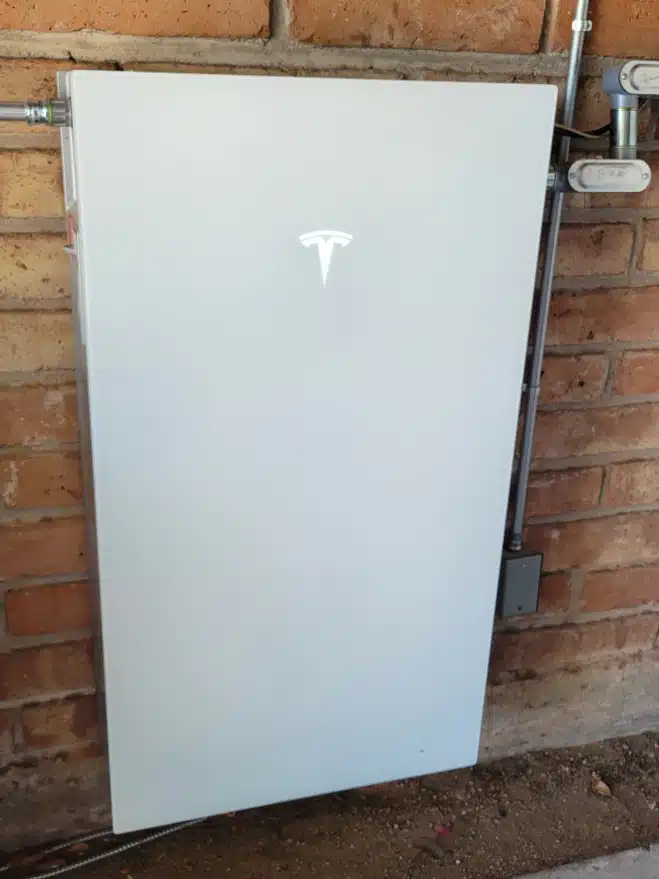
Residential battery backup system installed at a Tucson home. Battery systems are available from several manufacturers and can help keep essential circuits powered during an outage.
Not long ago, home battery backup systems were considered a luxury.
The technology worked, but for many homeowners the price was difficult to justify. Battery capacity was limited, installation costs were high, and most people simply relied on the utility grid when the sun went down or the power went out.
Today, the conversation has changed.
Advances in battery technology, increased manufacturing capacity, and growing demand for energy storage have dramatically reduced costs while improving performance. As a result, many Tucson homeowners are taking a second look at battery backup systems that may have seemed out of reach just a few years ago.
The Cost of Battery Storage Has Fallen
One of the biggest changes in the residential energy market has been the decline in battery prices.
As electric vehicles became more popular and battery manufacturing expanded worldwide, the cost of producing battery cells dropped significantly. Increased competition among manufacturers has also helped drive prices lower.
At the same time, battery systems have become more capable.
Modern battery backup systems offer more storage capacity, longer service lives, advanced monitoring features, and improved efficiency compared to earlier generations.
In many cases, homeowners can now purchase substantially more backup power than they could have for the same budget just a few years ago.
Evening Energy Use Creates New Challenges
For many Tucson homeowners, the biggest electrical demand doesn't happen in the middle of the day when solar panels are producing the most power.
Instead, energy use often spikes between 5 p.m. and 9 p.m., when outdoor temperatures are still extremely hot and air conditioners continue working hard to keep homes comfortable.
This is also when many families return home and begin using more electricity. Electric vehicle charging, laundry, cooking, entertainment systems, and other household activities can significantly increase energy consumption during these evening hours.
The challenge is that solar production is declining or has already stopped by this point in the day.
Battery storage helps bridge that gap by storing excess solar energy generated earlier and making it available when homeowners need it most. Rather than pulling all of that power from the utility grid during peak evening hours, homeowners can use energy they've already produced and stored.
Solar Panels and Battery Storage Work Better Together
Many homeowners already have solar panels installed.
In the past, it often made sense to send excess solar production back to the utility grid and rely on the grid when electricity was needed later.
Today, many homeowners are asking a different question:
Why not store more of that electricity for later use?
A battery backup system allows excess solar production generated during the day to be used later in the afternoon, evening, or during a power outage.
Instead of sending all of that electricity back to the utility, homeowners can keep more of the energy they generate themselves.
Backup Power Matters More Than Ever
Saving money is only part of the equation.
Many Tucson homeowners are also interested in what happens when the power goes out.
Monsoon storms, vehicle accidents involving utility poles, transformer failures, and other unexpected events can leave entire neighborhoods without electricity.
A battery backup system can help keep critical circuits operating when utility power is unavailable.
Depending on the system design, batteries may be able to support:
- Refrigerators and freezers
- Internet and Wi-Fi equipment
- Lighting
- Medical devices
- Security systems
- Garage door openers
- Selected outlets and household circuits
For many homeowners, that peace of mind is just as valuable as any potential utility savings.
New Battery Technologies Are Expanding Possibilities
Lithium-based batteries currently dominate the residential battery storage market, but the industry continues to evolve rapidly.
One of the most promising developments is sodium-ion battery technology.
Sodium-ion batteries have the potential to reduce manufacturing costs while relying on more abundant materials. They also show promise for stationary energy storage applications where weight is less important than cost, longevity, and safety.
While lithium batteries remain the standard today, emerging battery technologies may create even more affordable options for homeowners in the coming years.
Is Now the Right Time to Consider Battery Backup?
For many homeowners, the answer may be yes.
Battery systems that once seemed prohibitively expensive are becoming increasingly attainable. At the same time, homeowners are placing greater value on backup power, energy independence, and the ability to make better use of the electricity they generate themselves.
The combination of falling costs, improved technology, and growing energy demands has made battery storage more attractive than ever before.
If you're considering a battery backup system for your Tucson home, JCP Electric can evaluate your electrical system, discuss your energy goals, and help determine whether battery storage is a good fit for your property.